Clearing the Green
How clean energy projects are destroying forests and watersheds that keep communities safe
From the island and mountains of Rizal to the watershed of Samar Island, wind energy projects are being built on the forests that protect communities from floods and landslides. The clearing has started, turbines are already being built, and downstream communities are already feeling the effects.
Lolita Silahis, 76, has lived her entire life in Talim, an island in the middle of Laguna Lake, that straddles Metro Manila and nearby provinces in the Philippines. Through decades of heavy rains and typhoons, the water flowing steadily from the mountain behind her through her community into the lake always remained clear and never flooded them.
Streets of Kinaboogan village on Talim Island flood as Typhoon Paolo (Known internationally as Typhoon Matmo) hits the Philippines in October 2025. Photo from Barangay Kinaboogan's Facebook page
Streets of Kinaboogan village on Talim Island flood as Typhoon Paolo (Known internationally as Typhoon Matmo) hits the Philippines in October 2025. Photo from Barangay Kinaboogan's Facebook page
But when a typhoon struck Rizal in 2025, a muddy flash flood tore through her home. Unbeknownst to residents, the mountain behind their community had been cleared and flattened by heavy machinery to make way for a wind energy project. Forests that had protected these communities from floods for generations were being stripped away, and all in the name of clean energy.
Talim Island is not alone.
Across Rizal and Samar provinces, utility-scale wind energy projects — many linked to the same Singapore-based energy firm behind the Talim project, Vena Energy — are being built on forest lands and protected areas that communities have relied on for generations for flood control. In at least two cases, communities have already experienced flash floods and muddy waterways, which residents attribute to land clearing at construction sites. Experts say the pattern is predictable: when steep slopes are stripped of their forest cover, and rainfall that was once absorbed into the soil instead rushes directly downhill into communities below.
As the Philippine government pushes to meet its renewable energy targets — 35 percent by 2030 and 50 percent by 2040 — projects run by privately run energy projects are being fast-tracked to keep pace.

Caption: The 54MW Pililla Wind Power Project in Pililla, Rizal is operated by Vena Energy. Photo by Chantal Eco
Caption: The 54MW Pililla Wind Power Project in Pililla, Rizal is operated by Vena Energy. Photo by Chantal Eco

The Pililla Wind Power Project in Pililla, Rizal as seen from Cardona town. The wind farm is operated by Vena Energy. Photo by Chantal Eco
The Pililla Wind Power Project in Pililla, Rizal as seen from Cardona town. The wind farm is operated by Vena Energy. Photo by Chantal Eco

A portion of Mt. 360 in Tanay, Rizal has been carved away to make way for the construction of wind turbines for Alternergy's Tanay Wind Power Project. Photo taken on 1 June 2025. Contributed photo
A portion of Mt. 360 in Tanay, Rizal has been carved away to make way for the construction of wind turbines for Alternergy's Tanay Wind Power Project. Photo taken on 1 June 2025. Contributed photo
What's happening on the ground
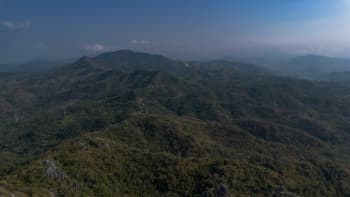
At the peak of Mt. 360, a popular hiking trail in the town of Tanay, Rizal, a flattened clearing and the tower of a wind turbine are now visible. One of the wind turbines for the Tanay Wind Power Project of Alternergy, a publicly-listed Filipino renewable energy company, is being built there. Alternergy is chaired by Vicente Perez Jr., who served as energy secretary from 2001 to 2005 under the Gloria Macapagal-Arroyo administration.
According to a resident of Barangay San Andres, who requested anonymity for security reasons, clearing of the mountain began in January 2025. When the rainy season arrived, streams flowing down to Barangay San Andres became muddy, which the resident attributed to clearing operations for the turbine construction.
"The stream in Mt. Mataripis used to run clear. Now it is clogged with soil from the clearing above, less water flows through, and when it rains, the water turns the color of chocolate," the resident said.
A regular hiker in the area, who also requested anonymity due to concerns related to his work, corroborated this account with photos and videos taken in June 2025 showing the stream running with muddy water.
The Environmental Reporting Collective (ERC) reached out to Alternergy for comment but received no response.
Based on the coordinates in the ECC for the Rizal Wind Energy Project, wind turbines will be built on all 13 ridges, every one of them inside protected areas in Rizal. Map by Amor Tan Singco
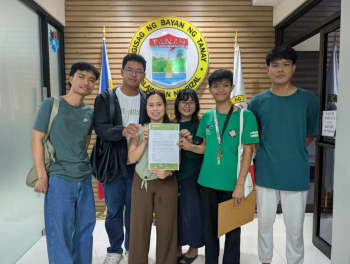
Masungi Georeserve, which has been restoring portions of the Upper Marikina River Basin Protected Landscape for three decades, said it was never consulted on the project.
"If ever Masungi really was consulted, we would really recommend for these projects to be transferred to a more suitable location," said Tristan Montemor, a biologist and Trail Operations Manager at Masungi Georeserve.
More than 50 organizations petitioned the Department of Environment and Natural Resources (DENR) to reject the project’s Special Use Agreement in Protected Areas (SAPA) application. A SAPA is a permit issued by the DENR that authorizes commercial activities within the boundaries of nationally protected landscapes.
In early 2025, Masungi Georeserve Foundation filed a cease-and-desist petition with the government. The DENR rejected it in March 2026. While the project remains halted, it’s ECC is still valid.
Earlier this year, Casimiro Ynares III, mayor of Antipolo City, also requested both the developer and the environmental department to review the proposed turbine location.
The ERC reached out to Rizal Wind Energy Corporation, Vena Energy, and the DENR CALABARZON Regional Office for comment, but have received no response.
Backhoe on the mountain
In the same province, 34 turbines are planned for the 219MW Talim Wind Power Project awarded to Island Wind Energy Corp., a subsidiary of Singapore-based Vena Energy.Residents said they only learned of the project when heavy equipment arrived and began clearing parts of their mountain on Talim Island.
A deforested and cleared area can be seen above Kinaboogan village on Talim Island, photographed in April 2026, where land is being prepared for the construction of the 218MW Talim Island Wind Power Project by Vena Energy. Photo by Chantal Eco
A deforested and cleared area can be seen above Kinaboogan village on Talim Island, photographed in April 2026, where land is being prepared for the construction of the 218MW Talim Island Wind Power Project by Vena Energy. Photo by Chantal Eco
Jayson Villones, 31, who grew up on the island and a co-convenor of KAPIT SA TALIM, a community group opposing the project, said no vehicle had ever reached the summit of Mt. Tagapo before construction began
"Before, we had no idea there was going to be a wind project built. I only started questioning what was happening on the island when we saw a backhoe working up on the mountain,” Villones said in Filipino.
He said he later confirmed what was happening after watching videos posted by a local content creator on YouTube. Villones said he knew of no public consultation about the wind energy project held in his barangay.
"The right of the people to know about this project was violated," he said.
The community group sent letters to local government offices and the Municipal Environment and Natural Resources Office (MENRO), which sent personnel to inspect the site. Operations were temporarily halted, but construction at the site resumed as of May 2026. The ECC issued by the DENR's Environmental Management Bureau in November 2023, covering 34 turbines across 27 barangays on the island, remains valid.
The ERC reached out to Island Wind Energy Corporation and Vena Energy for comment, but have received no responses.
The forest above Calbayog
Efren Reyes, the village chief of Bayo in Calbayog City, which sits inside the protected landscape, was newly elected when the Protected Area Management Board (PAMB) for the CPHPL convened village chiefs in 2024 and had them sign resolutions endorsing the project.
He claimed that at the time, he did not yet fully understand his role in the PAMB at the time, or which document he was signing or had signed.He had merely followed the other village chiefs, he said
"They should have explained it to us in our local language or translated the information about the project for us. Not all village chiefs graduated from elementary or high school," Reyes said in the Waray language.
He was not alone.
Gemini's own Environmental Impact Statement annexes show that 14 host barangays submitted resolutions endorsing the project. An analysis of these documents shows all 14 were written in the same standardized template, with identical phrasing, structure, and whereas clauses, down to the same sentence stating the project would "contribute to lessening the dependency of the Philippine economy on fossil fuels."
Some were fill-in-the-blank pro formas, with barangay names and dates handwritten into blank spaces in a pre-printed document. The only details that differ from one resolution to the next are the barangay name, the session date, and the names of the officials who signed. All 14 resolutions explicitly state they are assignable to the company's affiliates.
Each resolution also claimed that project presentations were held where procedures and effects were "satisfactorily explained" to the village council.


Environmental advocates in Calbayog City knew as early as 2023 that Gemini Wind Energy Corporation had filed an ECC application with the DENR-EMB, even as the city council submitted a resolution endorsing the project. But the application moved faster than they expected. The ECC was already approved before the public hearing for Calbayog City residents was even held in October 2025 — a reversal of the sequence the process is supposed to follow. The PAMB had already issued a favorable recommendation for the project, allowing Gemini to secure the ECC in September 2025.
Harold Mercurio, an academic at Northwest Samar State University and Vice President of Save Calbayog Rivers Foundation, a Concerted Effort (SACRIFICE), said they were blindsided.
A public hearing called by the Sangguniang Panglungsod (City Legislative Council) at the Calbayog Convention Center on October 17, 2025, attended by city government officials, civil society and academe representatives, and a representative from Gemini Wind Energy Corporation (GWEC). By the time of the hearing, the city council had already endorsed the project in 2023. Photo supplied
A public hearing called by the Sangguniang Panglungsod (City Legislative Council) at the Calbayog Convention Center on October 17, 2025, attended by city government officials, civil society and academe representatives, and a representative from Gemini Wind Energy Corporation (GWEC). By the time of the hearing, the city council had already endorsed the project in 2023. Photo supplied
"We were caught off guard by how fast they processed the application. We only found out the ECC had already been approved at the public hearing they held at NwSSU [Northwest Samar State University],” Mercurio told ERC.
SACRIFICE led a signature campaign, filed objections, and publicly raised the alarm after learning that 13 of the 37 turbines were sited within the protected landscape.
"How can you be green if thousands of trees will be cut down? This is legal deforestation based on the ECC and the cutting permit that will be applied for with the DENR.," Mercurio said.
According to Gemini's project description and Environmental Impact Statement, the total application area spans more than 10,000 hectares, although the actual footprint of turbines, roads, and supporting infrastructure is expected to occupy roughly 255 hectares. No final estimate has yet been released on the number of trees that will becut.
Silverio Palima Sr., the village chief of San Joaquin and a member of PAMB, the Protected Area Management Board, said the board's position eventually became clear that the turbines cannot be allowed within the protected area.
The opposition pushed the Sangguniang Panlungsod to pass a resolution in November 2025 strongly opposing turbine construction inside the CPHPL. By February 2026, Vena Energy presented a revised design to the city council with no facilities inside the protected landscape.
The council then passed SP Resolution No. 2026-08-113, conditionally approving the project — provided all facilities, including access roads, remain outside the CPHPL. The resolution also noted that the project will not directly supply electricity to Calbayog City.
But even as the council deliberated, Gemini had already begun compensating residents for trees to be cleared from their land. In March 2026, Alona Caridad, 52, of Barangay San Joaquin received PHP15,000 (USD244) for two coconut trees on her land. She was told the area will be used for an access road. A company representative came to her home with a check. She signed an acknowledgment receipt, but was not given a copy.
"The area where we used to farm will be part of the access road," Caridad said in Waray.
Other residents of Barangay San Joaquin confirmed they also received payments for the clearing of their coconut trees, but declined to be identified for this story.
Palima said he refused to issue the barangay certification that Gemini needed to pursue its right-of-way permit applications.
Engr. Hennency Hayag of the Environmental Management Bureau in Region 8 said the ECC was issued because Gemini followed the required regulatory process, including securing a favorable recommendation from the PAMB. He confirmed that Gemini has since filed an amendment to the ECC, revising the project design to move all turbines outside the protected area.
"No turbines are now inside the protected area," Hayag said.
But he confirmed that the full Environmental Impact Study for the amended project has not yet been submitted, and no amended ECC has been issued. The 24 turbines proposed in the adjacent forest land remain part of the application.
The ERC has also reached out to Vena Energy for comment for this story, but have not received any response.
Will the wind energy projects worsen flooding?
Eva Prudenciado, 57, was born and has spent her entire life in Caglanipao Sur village in Calbayog City. As the village's disaster risk reduction head, she has spent more than a decade tracking floods, organizing evacuations, and keeping records of every extreme weather event that has hit the community. In all those years, she had never seen floodwater rise the way it did during Tropical Storm Ramil (known internationally as Tropical Storm Fengshen) last year.
“In just minutes, the water suddenly rose, the flood surpassed the barangay, which happened for the first time,” Prudenciado said in Binisaya, noting that it was not even a super typhoon.
Caglanipao Sur is one of 14 host barangays for the Gemini Wind Energy Project.
Prudenciado connects what happened to years of illegal logging in the mountains behind their community with no replanting.
“There is nothing left to protect our water in the mountains,” she said.
Eduardo Espejon Jr., a licensed forester at Northwest Samar State University, explains the mechanism behind what Prudenciado describes. He said that when steep slopes lose their forest cover, rainfall no longer has roots and soil structure to slow it down. It runs directly off the surface, picking up eroded soil and gaining speed as it descends. Communities at the base of those slopes absorb the result.
"Whatever you do in the uplands always comes back to our lowland communities," Espejon said.
Full ecological recovery from large-scale clearing, he added, takes a minimum of 20 to 40 years if done correctly, with the right species and consistent protection.
In Rizal, the stakes extend further downstream. Tristan Montemor of Masungi Georeserve describes the karst landscape of the Upper Marikina River Basin as a sponge that collects rainfall from the surrounding mountains and releases it gradually, regulating water flow for communities as far as Metro Manila.
Global Forest Watch data shows Rizal province lost more than 5,000 hectares of tree cover between 2001 and 2025. The pace of loss has been accelerating — 2025 recorded one of the highest annual figures in a decade.
Mountain ridges cleared for the construction of Alternergy's Tanay Wind Power Project, seen in the mountains of Cuyambay village in Tanay, Rizal. Photo taken in April 2026. Photo by Chantal Eco
Mountain ridges cleared for the construction of Alternergy's Tanay Wind Power Project, seen in the mountains of Cuyambay village in Tanay, Rizal. Photo taken in April 2026. Photo by Chantal Eco
"We can already see the effects of forest degradation. We get to experience intense flooding, we get to experience stronger storms," Montemor said.If the remaining forest is further fragmented by turbine construction, roads, and powerhouses, he said, the impacts of flooding and droughtdownstream would intensify."For these megastructures to be built in protected areas, it would really be very difficult for us to restore a huge portion of the ecosystem, if not impossible," Montemor said.
SACRIFICE and other community groups said they are not opposed to renewable energy development. But for them, the projects’ locations are the problem.
“We have to make sure that we do not lose our dependable and abundant supply of water, and that we do not compromise our forest cover in the next 50 to 100 years for the next generation,” Mercurio said.
Back in Calbayog City, Prudenciado fears that wind energy construction will further strip the slopes, and that the company's promised rehabilitation will come too late.
“How many more years before the trees grow back? ” she asked. “My generation will not live to see it.”
This story was produced with support from Internews’ Earth Journalism Network.
 Built with Shorthand